On this page, I have three accordions that contain my completed essay, in-class assignments that helped me develop this assignment, as well as an excerpt on the interviewing process I used.
Examining the Aerospace Engineering Discourse Community at UCF
Introduction
Here at UCF, most students find themselves in a community, whether they chose it or not. This can be clubs, friend groups, majors, Greek affiliations, and hundreds of other groups. Many of these groups can be classified as something called a discourse community, which is a community of people who share interests, goals, and ideas amongst each other. My community is The American Institute of Aeronautics and Astronautics. The discourse community of AIAA plays an important role in shaping the future of aerospace engineering; it assists future engineers in learning to communicate, collaborate, and contribute to the field. The club provides members with the opportunity to participate in projects, competitions, research, and networking within the field. Studying the UCF chapter of AIAA is worthwhile because it allows me to show how learned practices from the classroom and daily life translates into professional environments and interactions. I have chosen to conduct my analysis through the framework of discourse communities, which I introduced earlier. This allows me to use several modes of evidence to support my research idea through media, communication types, and shared goals from other members of the organization. This allows me to highlight not only the group’s activities, but how insider communication leads to completed objectives.
AIAA is a technical organization, and like many other engineering clubs, it is centered around structured communication. In my past research, I discussed that academic as well as professional engineering societies use specific genres of communication, such as lab reports, proposals, competition reports, and tech developments. All these genres are heavily targeted to a certain audience and rely on data rather than normal social expression. AIAA functions similarly to this but also has a strong social platform to encourage relationship building. We share our work and communicate through different digital platforms such as social media and discord servers, and in-person meetings. These characteristics build a foundation for my analysis of how AIAA carries the features of a discourse community.
I started conducting my research by choosing methods of communication within the community. Before I discuss those, I want to explain what led me to choose these methods and how I approached gathering data. John Swales and Ann Johns provided me with a definition and explained how to translate AIAA’s activities into the terms of a discourse community; a discourse community is a method of studying how a specific group of people use communication to meet their collective goals, connect with each other, and nurture a sense of belonging within each member. On top of John’s connection to emotional fulfillment within a community, she describes how social concepts translate to academic discourses. She also described the different values, identities, and hierarchies within groups that eventually lead to sub-communities and ever-developing systems (John 51-70).
In connection with this academic viewpoint, a study by Karl-Heinz Pogner is especially useful in starting to translate relationships between engineers and correlate that to AIAA. Pogner examined two Danish engineers’ reports while they worked on a grid system and concluded that, while hollow and technical, the interactions between the workers were indeed social (Pogner 855-867). Similarly to the work done in AIAA, the engineers offer each other advice, discuss issues as well as their solutions, and work together to meet a goal. Engineers communicate differently from most people, and this makes them seem to deviate from social norms. This linguistic barrier dissolves in the AIAA discourse community, keeping it exclusive. These communication abilities are a necessary foundation in the engineering community, as emphasized in Annie Attan and Wan Fakhruddin’s article about applying knowledge to lab reports (Fahkruddin 1501-1512). Shared research, interaction, and evaluation from peers are all key to work done in the AIAA chapter here at UCF. Without the proper skills, data and ideas can be lost easily between project partners, and builds could suffer because of it.
_____________________________________________________________________________
Methods
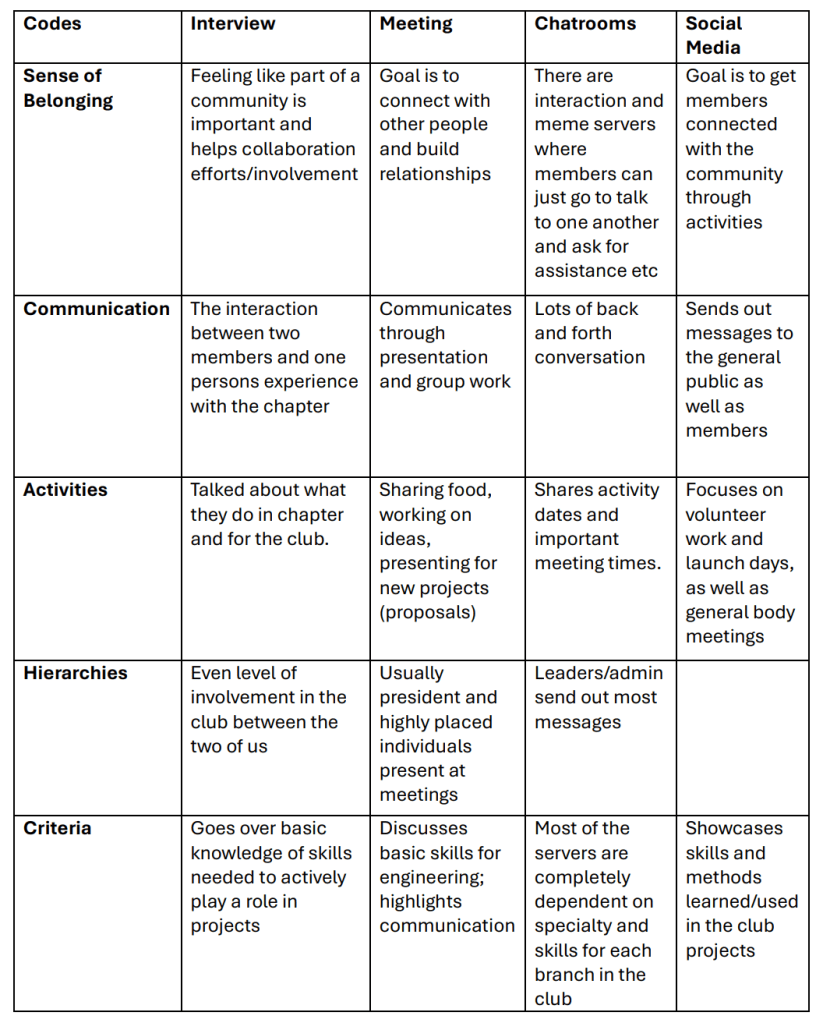
I used four primary source analysis methods to conduct this research: an interview, attending meetings, and breaking down social media and chat server pages.
Firstly, the interview was helpful towards my research and pushed development in discerning communication practices within the site. It was nice to gain an outside perspective on interactions between members and how this communication is perceived. It connects well to my analysis of social media page interactions and may provide further understanding towards those interactions. While it would’ve been nice to get the opportunity to interview a member who has more experience, this time spent wasn’t wasted and provided a solid perspective on how members begin building relationships within the chapter.
The main social media platform I examined was the UCF AIAA chapter’s Instagram page. It’s a page full of information on events, deadlines, and volunteering opportunities. It hasn’t been as active this semester in terms of posts, but in previous fall semesters, it’s been regularly updated. The page is a good representation of how AIAA represents itself to nonmembers. It shows the community activities that define discourses, such as highlighting meeting events, volunteer updates, and general interaction between members. Comments and tags also show participation in the events by members, strengthening the argument that AIAA is a well-rounded and involved community. The images used also help me develop ideas based on purposeful branding and engagement that I don’t receive from chat servers.
Despite the lack of a purposefully curated face, the discord server source was especially helpful in my research on club activity. Within the servers lie every event, challenge, and update about every little thing that goes on in the chapter here at UCF. The chatrooms capture the everyday conversations between members, including every aspect of the chapter and what members are required to attend and do. While the social media handles show the public what the club does, the discord server contains all the information that only members are privy to. The language within the chatrooms is also representative of the definitions provided by Swales and Johns, meaning it’s mostly technical and exemplary of complex terminology that only members or individuals in similar fields would understand. In addition to this, the server is divided into separate chats, showing the levels of club integration and each specialty that members may have. The discord server allows me to record data in real time, rather than just analyzing and interpreting socials and other sources. Overall, it provides another solid foundation on how the chapter shares goals, organizes member involvement, and creates an atmosphere of belongingness/identity through communication.
Finally, at AIAA meetings, the main concept is presentation and integration. It’s all about community and inclusion and is similar to a group hangout. Of course, important deadlines and projects are discussed, but most of the general body meetings are accompanied by free pizza and friends met along the way. This develops the social aspect of a discourse community further, going hand in hand with the social media source. General body meetings are open to members of every level, as well as potential members. This source deviates from the associated stigma of all work and no play that stem groups tend to have. It’s another example of live-research, meaning I can observe it in real time. Unlike digital platforms, meetings bring members together for real face-to-face interactions, which build connections and relationships. Members can engage with leaders’ presentations via questions and commentary; this supports the discourse community trait of communication and feedback.
_____________________________________________________________________________
Results and Discussion
AIAA focuses heavily on member interest, so to showcase this devotion to involvement, I conducted an interview with a friend of mine (see Appendix A for questions asked and Appendix B for responses). In my interview with a fellow chapter member, I focused on his opinions on communication within the chapter and how he’s connected the aerospace major’s curriculum to club activities/experiences. We discussed that AIAA focuses heavily on rocketry concepts, which is an understandably popular interest within the major. All of this effort put into manufacturing and brainstorming concepts requires a great deal of communication and understanding. These are both vital pieces to the chapter and determine outcomes of projects and relations between members. During this interview, we deemed that the most influential area for communication is the discord server for aviation design and DBF (design build fly). These include heavy amounts of specialty jargon but are accommodating to users who are new to the forums. The individual I interviewed admitted to not being particularly involved in those chatrooms, but frequently reads the general and announcement tabs to keep up with club events and group chats discussing general interests. Discussing these chatrooms and overall involvement throughout this interview, AIAA is obviously concerned with ensuring the social and professional involvement aspect from members. This leads me to discuss my analysis on meetings and the chapters Instagram page. Both research sites provide ample examples of characteristics found in discourse communities (based off definitions provided in my earlier mentioned secondary sources).
There are a multitude of roles within academic groups such as this one, each with different skills and accomplishments. Membership within the group isn’t a stationary relationship; it’s continuously developing. Growth in this category requires commitment, communication, and practice. This highlights that not all members experience AIAA in the same ways, and that there are levels to learning the language the chapter uses.
Approaching Problems Through Social Mannerisms
All of this exertion put into building a tight-knit community isn’t just for fun; it shows that members work well together and aren’t afraid of correcting one another. Social personalities are generally more approachable and work well in teams, which is what the chapter at UCF is all about. In Pogner’s research on the Danish engineers working on a subdivision, it’s heavily emphasized that without interaction, projects and work quality would suffer (Pogner 855-861). A close community is important for a lot of members because it provides a sense of comfort when looking for help or offering guidance to others. Without that blanket, it would be a lot more daunting to approach others for help with complicated tasks such as the ones AIAA assigns.
Solving Problems Through Applied Knowledge
In the meetings I mentioned earlier, in addition to the social characteristics, members put their skills to use when building their projects. This introduced one of the chapters shared goals, which is a required aspect to have in discourse communities. The idea of ‘teamwork makes the dream work’ is a perfect way to describe a majority of, if not all, projects done within the chapter. Groups of students work together on building amazing planes, rockets, drones, etc., and each student usually has a different specialty than the others. For example, in my lab this semester (which is almost the exact environment AIAA provides), my group members and I all have completely different skill sets; one’s good at CAD, one’s good with hands-on building, one’s good at mathematics, and I’m good at coding. Each group can decide what everyone’s strength is, then apply that to the project for the best result.
Funnily enough, utilizing your skills to apply knowledge to problems is the best quality someone in AIAA or engineering can have, not being an Einstein-level genius. While your professors and TAs will help you, most of the answers you’re going to find are pure trial and error on your part. All of this brings me to Fahkruddin and Attan’s research on students crafting their proposals and reports. It’s widely accepted in the engineering community that students won’t learn the skill if you just tell them; they need to experience the situations on their own, and professors are there to provide a helping hand when they get stuck. This winded banter on essentially being thrown straight into the lion’s den connects to AIAA by standing as an example of the integration of knowledge in a specific setting. Much like our project proposals and presentations, the students described in the article are required to update and present their findings in a professional way (such as a lab report to a professor or tweaking a model assignment). Fakhruddin and Attan explain that mastering the genres of professionalism and linguistics will help students master the standards required in this field of study.
_____________________________________________________________________________
Final Thoughts
Overall, my research on the AIAA chapter here at UCF proves exactly why the club is a model example of a discourse community. Through all this examination of interactions, meetings, social perspectives, and comparison to examples of educated writers, it’s obvious that communication is not only necessary for success in the program, but also to building lasting relationships with other members and professionals. The type of balanced relationships that the chapter fosters help grow a healthy environment for both new and experienced members.
In addition to this social aspect, the research explains how AIAA connects academic learning with professional practices. Members not only learn how to utilize skills learned in the classroom, but how to translate these skills into a presentable, professional lexis. This can all be practiced through communication in projects, through chatroom conversations, or meeting engagement, members are always honing their skills in reference to professional experience and communication.
Examining how AIAA represents discourse communities also reinforces the idea that communication is abundantly important to stem majors and communities. The field is often seen as purely technical, but the analysis on communication really enforces that social interaction, relationships, feedback, and understanding are all equally as critical as educational experience. As a discourse community, AIAA creates the perfect conditions for students to grow both academically and professionally to prepare them for their future careers.
Excerpt: AIAA focuses heavily on member interest, so to showcase this devotion to involvement, I conducted an interview with a friend of mine (see Appendix A for questions asked and Appendix B for responses). In my interview with a fellow chapter member, I focused on his opinions on communication within the chapter and how he’s connected the aerospace major’s curriculum to club activities/experiences. We discussed that AIAA focuses heavily on rocketry concepts, which is an understandably popular interest within the major. All of this effort put into manufacturing and brainstorming concepts requires a great deal of communication and understanding. These are both vital pieces to the chapter and determine outcomes of projects and relations between members. During this interview, we deemed that the most influential area for communication is the discord server for aviation design and DBF (design build fly). These include heavy amounts of specialty jargon but are accommodating to users who are new to the forums. The individual I interviewed admitted to not being particularly involved in those chatrooms, but frequently reads the general and announcement tabs to keep up with club events and group chats discussing general interests. Discussing these chatrooms and overall involvement throughout this interview, AIAA is obviously concerned with ensuring the social and professional involvement aspect from members.
Appendix A: Interview Questions for Primary Source 1
- “How have you enjoyed being in AIAA so far? And…[what] kind of projects have you seen if any?”
- “Do you want to get involved more [with the chapter] in the future?”
- “Do the semester projects [in engineering classes] help you understand what to do and how to accomplish things in AIAA?”
- “What kind of communication do you use most often with the club?”
- “Which parts of that [the discord server] do you read the most or respond to?”
“How do you feel about the social aspects within the chapter, or where do you think people interact the most?”
Appendix B: Interview Responses and Notes- see Appendix A for questions
In response to question 1:
Respondent: “I mean, I like building projects… the people are nice too. I haven’t worked on anything yet [because] I’m only a freshman.”
Response to question 2:
Respondent: “Yeah for sure, I mean it’s really just a time crunch thing right now. I’m sure I’d be more involved if I didn’t have so much to do. I’m just swamped with work and the sub (in reference to our engineering project) meetings we’ve got going on, [so there’s] not a lot of time for exploring this semester.”
Response to question 3:
Respondent: “Oh definitely. I go into those classes, yknow, not really knowing what I’m doing, then I leave with a bunch of new experiences under my belt sort of. It gives you kind of a hands-on experience in terms of like, building and coding for projects. I wouldn’t really know how to do any of that stuff without labs1… yeah basically it just helps me know how to talk to others and people who are presenting. I can’t really say how much it helps with actually building, since I haven’t done that in the chapter, but they teach us how to talk in a professional engineering setting, so I’ve used that a lot.”
Response to question 4:
Respondent: “Honestly, I talk the most to you about it [since] I don’t know many people in the club as well as you yet. Other than that, I read the discord servers a lot cause they’re interesting to look at.”
Response to question 5:
Respondent: “I don’t really respond to anything. I read the general page any time i see announcements so I can know what’s going on, and the meme page is pretty funny, so I look at that from time to time. I like to look at the aviation page too, so I can see what they’re building. It’s kind of crazy to see all of the designs going in and out every day.”
Response to question 6:
Respondent: “Oh definitely the discord server for sure. I don’t think I’ve seen a day go by without notifications popping up from people. But yeah everyone’s really nice and they just wanna help you get involved. Plus there’s a lot of like, opportunities outside just building. I mean you get to talk to the presenters and club leaders if you just go up to them. I feel like a lot of times I see them as kind of unreachable cause they’re so much older and experienced, but you can really just walk up to them and start talking.”
Analysis: This excerpt from the Results and Discussion portion of my essay on the discourse community of AIAA best approaches the course outcomes of research genre production and contributing knowledge. The interview and questions I refer to allowed me to apply my knowledge on my subject to best determine what was helpful to my argument, and what wasn’t as well as what interview questions I asked and how I translated them into my work.
 My Progress in Writing Through ENC1102